Histopathology ST1 2027: The Ultimate Guide
Everything you need to know before you apply
Last updated
Why Histopathology?
If you're weighing up Histopathology for ST1 in 2027, then look no further. This guide goes through everything you need to know.
Histopathology gets overlooked by a lot of foundation doctors simply because it's less visible on the wards. To be totally honest, when I submitted my application I submitted it on deadline day. That's not because I had spent a month preparing it, it's more that I only decided to do the application on the very last day. But that's a story for another time.
Histopathology is a great career, because the specialty offers something increasingly rare in modern medicine: genuine diagnostic ownership, balance to your life and intellectual rigour. Piecing a puzzle together and developing a clinicopathological correlation is genuinely a fascinating journey. In clinical medicine you often settle for treating symptoms; ultimately the answers don't matter that much. But in histopathology your whole journey is about the underlying question, finding the answer at the end of the road, and that is often the thing that determines a patient's treatment pathway.
On top of that: no nights, no weekends, and a specialty that is continually developing. Digital pathology, molecular diagnostics and subspecialisation into areas like dermatopathology or GI pathology mean the job you train into won't look identical to the one your consultants trained into. There's room to carve out a niche, publish, teach, and build a career that suits you.
Not that we are trying to convince you 😉
Our role is to prepare you. Applications have been becoming increasingly difficult in recent years; even the pre-interview scoring systems have been increasing from below 30 to 40+ in the most recent iteration. Below are our considered thoughts on the likely transition.
What's Changing for the 2027 Cycle
The single biggest shift for anyone applying to start in August 2027 is how prioritisation now operates. Under the Medical Training (Prioritisation) Act, the 2026 intake saw prioritisation applied only at the offer stage, after shortlisting and interviews had already taken place. From the 2027 round onwards, prioritisation now applies at shortlisting as well as at offer.
In practice, this means the composition of who even gets invited to interview is likely to look different from last year, not just who ends up with a post at the end. Applicants also need full GMC registration in place at the point of application rather than sorting it out afterwards, and Round 1 applications for CT1/ST1 programmes are capped at five, so the days of scattergun applying across specialties are gone.
We think the gradual inflation of points required to get an interview is unlikely to continue, and that UK medical graduates are more likely to get interviews and, in turn, offers.
What will happen in terms of number of applicants? This is harder to predict. Whether fewer IMGs will apply is unclear; it's worth bearing in mind that over the last two to three years, greater numbers of applicants have failed to land their desired job, so there is a backlog of UK medical graduates who will now see an opportunity to land their first-choice specialty, which may see increases or consistency in applicant numbers. Roughly, for histopathology, the applicant-to-offer ratio was around 10:1 last year. Once at interview stage, it's approximately 2 to 2.5:1.
Another reason we expect score requirements to come down this year is that the scoring criteria themselves have changed. We will discuss this in more detail during our webinar on 1st November, but consider, for example, the changes to Domain 9: Commitment to Histopathology as a Specialty. In previous years, a taster week would automatically have earned you 10 points; this year it will only get you 8 points, a 20% decrease. To score those 10 points you now need a foundation programme rotation or another extended period of training in histopathology lasting 3 months or more, and the number of people who have this is incredibly small. Other changes across the board mean applicants are likely to score fewer points overall.
Last Year: Application Cycle
Talk to anyone who interviewed for Histopathology ST1 in the 2026 round and one theme comes up repeatedly: they underestimated how much actual pathology knowledge the interview demanded. Many candidates had prepared as though this were a generic values-based NHS interview, heavy on motivation and portfolio talk, light on subject matter. That assumption cost people. Sometimes it isn't necessarily that they don't get a job offer, but instead it isn't their first choice.
The format has been largely consistent over the last few years: two stations covering six questions in fifteen minutes each, and pathology content was woven through most of it. The format has been increasingly time-pressured, with many candidates telling us they felt rushed, which is why they often say our mock interviews were the best practice they did. All of the case-study-based questions were very much contextualised to real pathology, so you needed to demonstrate genuine pathology knowledge.
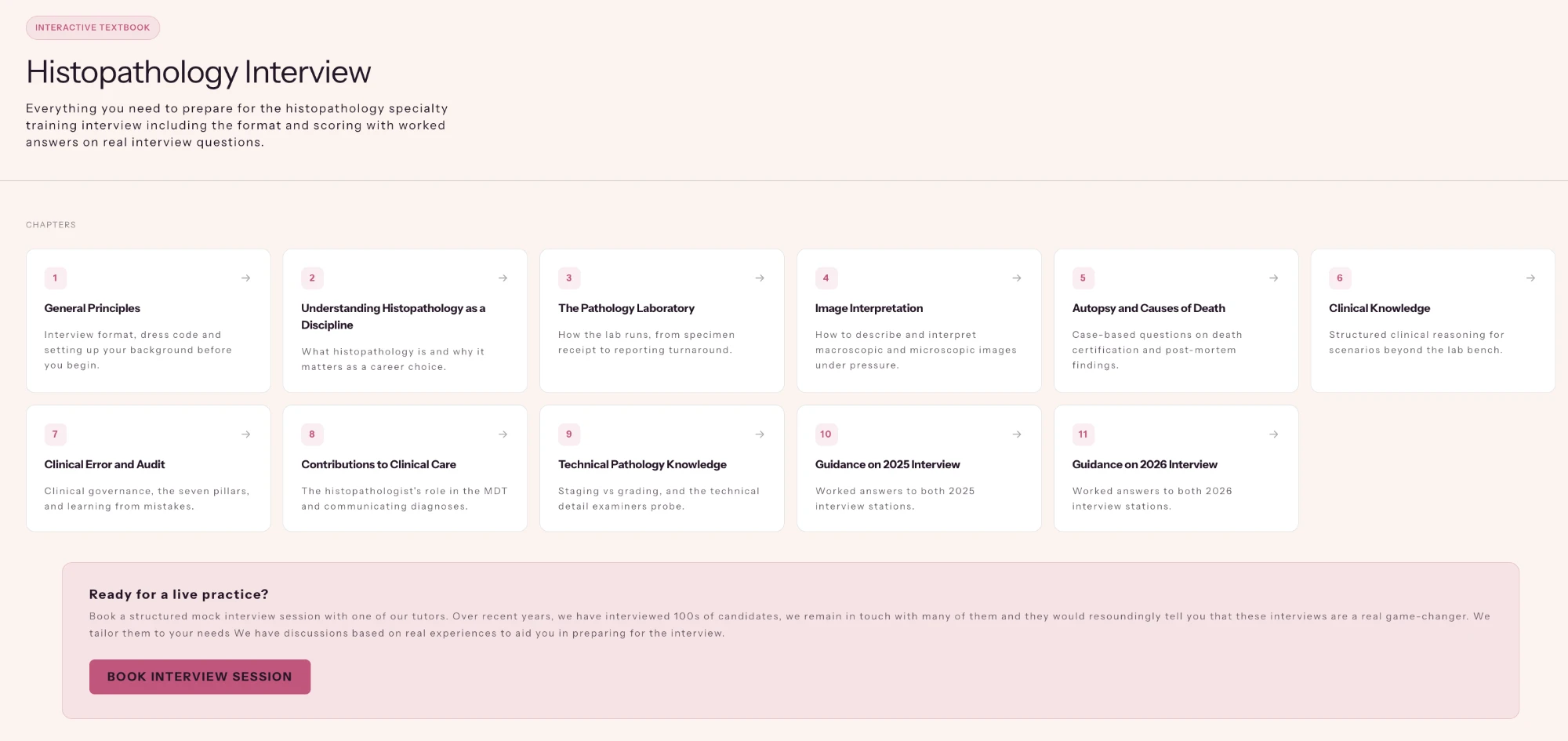
That is the gap that an up-to-date, trustworthy resource helps you close (dare I say our platform is probably the best place for this, and this year we have revamped and updated everything for the latest cycle). If you walk in assuming this is mostly about communication skills and enthusiasm, you'll be caught out in the same way plenty of last year's candidates were.
But maybe we are running ahead of ourselves. Before we get to the interviews themselves, we need to submit evidence, and so on.
Join Us on 15th October
We're running a live webinar on 15th October covering everything in more depth: what the 2027 prioritisation changes mean in practice, how to read the new shortlisting criteria, how to submit your evidence, and what the interview stations are actually testing based on real candidate feedback from the last cycle. There'll be time for questions.
Ready to start your ST1 2027 preparation?
Expert-curated interview questions, an interactive textbook, and mock interview sessions, all updated for the 2027 cycle.
View histopathology package →Contact us on +44 724 205 585 if you have any questions, follow us on Instagram, or join the WhatsApp group for applicants.